

Field terminology

The demi-monde
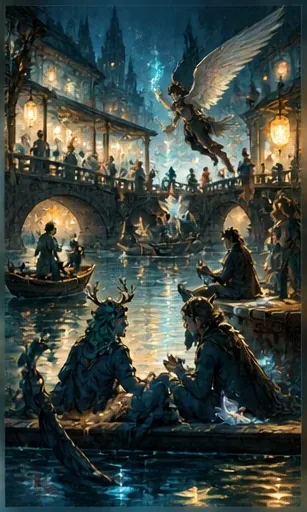
The loose community of people and beings connected to the supernatural.
Story context
The loose community of people and beings connected to the supernatural. Choose a reading route to explore the setting in context.
The demi-monde: a useful name with limits
First reading stop: Rivers of London. The first novel’s official description moves Peter Grant from an ordinary police investigation into encounters with magic and unusual people. For a concise definition of demi-monde, the licensed roleplaying game says it includes people and creatures touched or changed by magic. That is a game glossary definition used here for orientation; this page does not claim that the novel introduces the precise phrase at a particular line.
The name describes a broad part of the setting, not a single organisation with a membership list. It can be tempting to treat a category as a shortcut for understanding everyone Peter meets. That would erase differences between individuals and between kinds of encounter. A witness, a neighbour, a powerful figure and a person needing help may all require different responses. The broad term is most useful when it reminds a reader that the supernatural world extends beyond formal practitioners.
The licensed game calls the Folly the police’s special magic branch and describes investigators dealing with the demi-monde. In a game, this gives players a clear starting premise. In the novels, the emphasis can shift with Peter’s particular case, what he knows at the time, and whose account he can verify. The game and books share a licensed setting, but a game procedure is not automatically a rule for every scene in the fiction.
How the books describe the world around Peter
The publisher’s opening-book account begins with a ghost witness and Peter’s recruitment by Nightingale. The author’s description also mentions river figures and other uncanny matters. These official summaries establish that Peter’s world has widened; they do not provide an exhaustive classification. The interesting question is often how he investigates a person or event before he has a reliable label for it. This guide’s use of demi-monde should remain subordinate to what a particular book actually shows.
That is why this page avoids a catalogue of supposedly universal powers. A newcomer can understand the basic distinction between the police team, a magical practitioner and a wider community without knowing the outcome of later cases. After reading further, return to the words people in the story use for themselves. A label applied from outside may not tell the whole story, and this is an editorial reading of the series rather than an attributed opinion of its author.
People and connections
Peter Grant is the first guide to open if you want the investigator’s point of view. Thomas Nightingale is the mentor who brings Peter into the specialist work. The Folly is the workplace from which that investigation proceeds. The Mama Thames and Father Thames files describe figures associated with a particular river world; they do not stand for everybody encompassed by a broad game term.
Real London behind it
The demi-monde is a fictional category. London’s streets, waterways and public places are real, but there is no verifiable real-world register of these fictional people and creatures. The river map helps you distinguish a real waterway from a character linked to it. The walking guide concerns public places, not an invitation to find a supernatural address. A claim about the city should be checked against a geographic or civic source; a claim about a character should be checked against the relevant book or official synopsis.
The phrase can sound like a complete world map, yet its breadth is precisely its limitation. It tells a reader what kind of setting a case may touch, while leaving the details of each encounter to the story. Our entries for genius loci and the river figures are narrower guides. Read them as connected viewpoints rather than nested boxes that perfectly sort every character.
Through Broken Homes · possible spoilers
After four main novels, consider which early assumptions Peter has revised about the people he meets through Folly cases. Notice when an investigation depends on a person’s choices rather than on their category. This is a discussion prompt, not a claim that a later book supplies an official list of demi-monde members.
Through Lies Sleeping · possible spoilers
At this point, compare the scale of Peter’s first case with the wider network of people and places now visible. Does the umbrella word still clarify a situation, or does it hide differences of power, history and circumstance? Use the particular book as evidence before answering.
Current with the main novels · possible spoilers
After Stone and Sky, ask how far a term learned in a London policing context travels when the setting changes. Avoid extending a game glossary beyond what the books establish. This is this site’s interpretive question rather than a new definition.
Sources and scope
Chaosium’s licensed-game description and game glossary supply the broad definition · author’s first-book description and publisher’s description support the opening premise. No exact novel usage of the glossary term is asserted.
Related files
Story world index · River map · Forma · Vestigia · Signare